
We’re Not Lazy, We’re a Consensus: Yellowstone to the Tetons
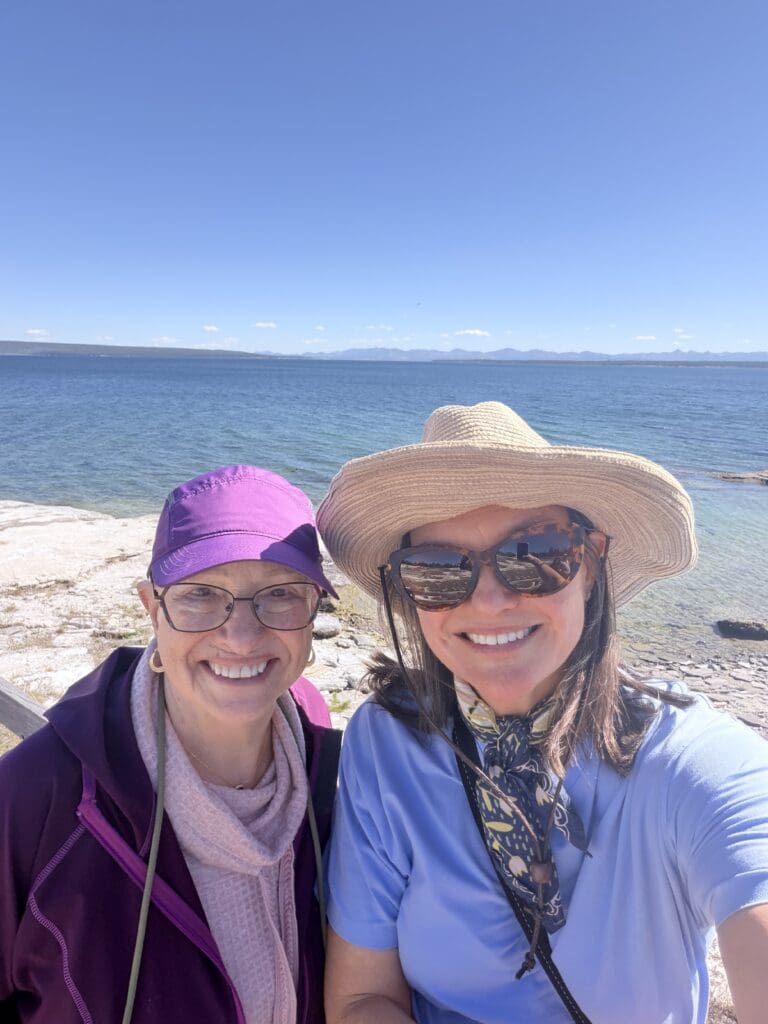
The next morning, Ed and Eileen offered to take us on a three-mile walk around Yellowstone Lake before breakfast. Mom’s legs had other plans. She was ready to sleep in, have a leisurely morning and enjoy the Lake Hotel. And frankly, I didn’t need much convincing. Also—and this is important—the Lake Hotel had a latte machine. After several days of hotel coffee, this felt less like an amenity and more like a reason to restructure the itinerary.
So, we decided to sleep in, have a late breakfast and just enjoy the hotel for a while. Apparently we weren’t the only ones feeling this way because more than half our group made the same decision. This made me feel better. We’re not lazy. We’re a consensus.
And I wasn’t worried. I knew Ed and Eileen would find some way to get our steps in before the end of the day. They always do.
Since so many of us skipped the morning hike, Ed and Eileen adjusted the schedule and took us over to West Thumb Geyser Basin on the shore of Yellowstone Lake.
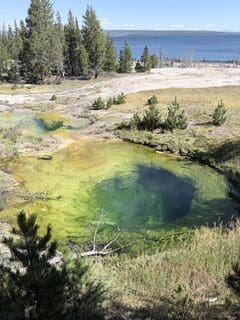
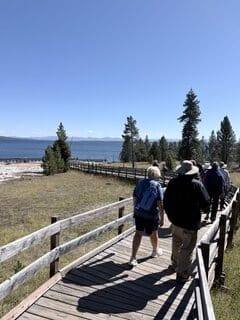
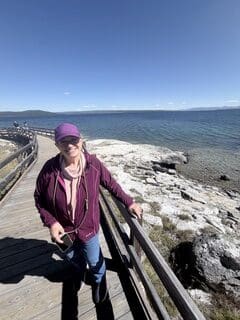
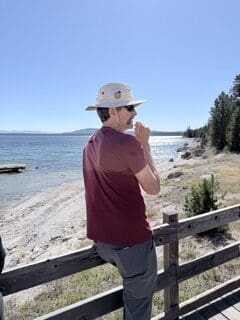
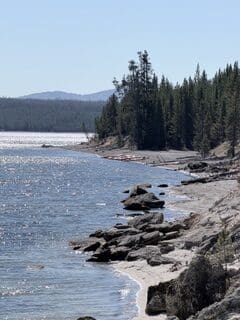
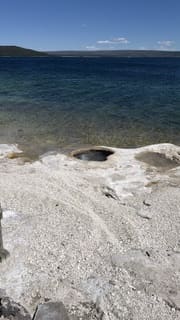
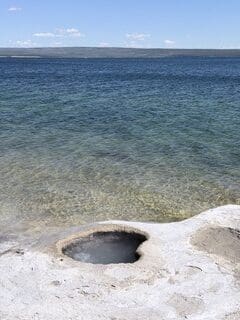
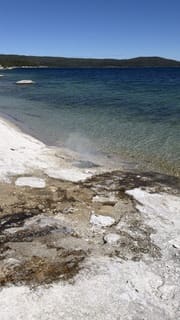
This is another one of those places in Yellowstone where you’re walking along a perfectly normal-looking boardwalk beside a beautiful lake, except the ground next to you is bubbling, steaming and occasionally bright turquoise. Yellowstone really doesn’t let you forget that you’re standing on top of something.
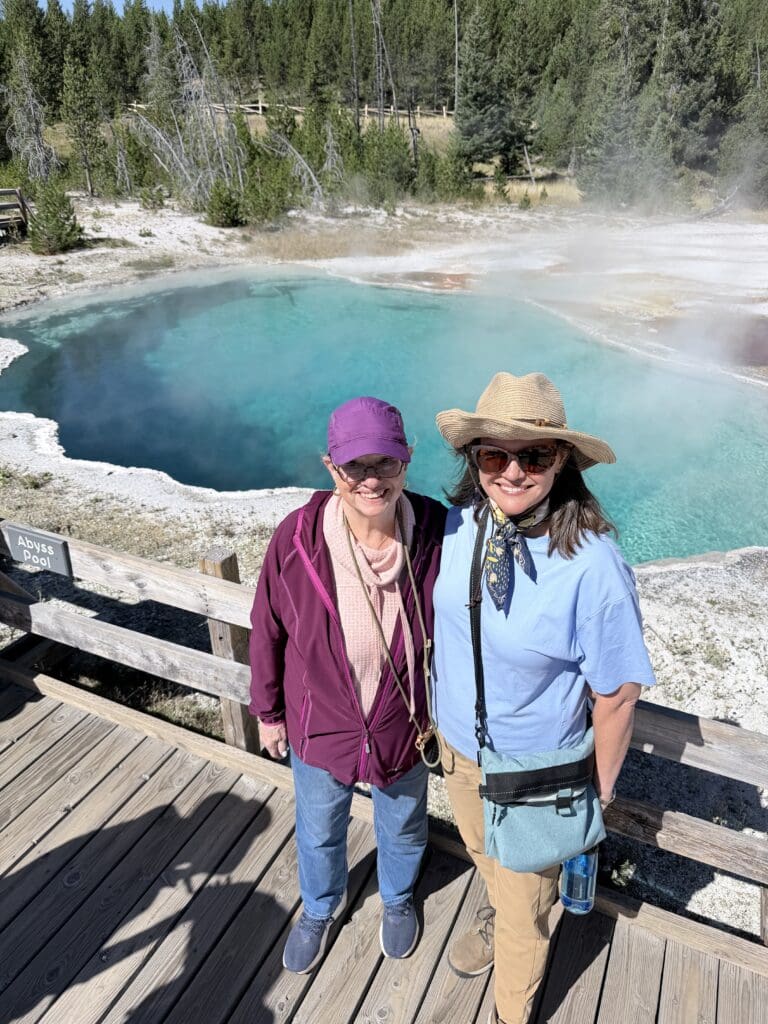
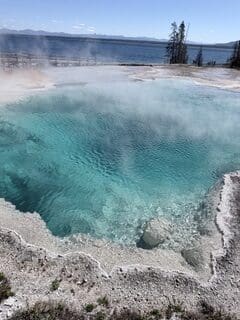
Ed, of course, was pointing out different features and telling us stories as we walked. Then, toward the end, he casually mentioned that years ago a human foot—still inside a shoe—was found floating in one of the hot springs. And suddenly I remembered: Oh! I’ve been here before! Not because I recognized the beautiful lake. Not because I remembered the geysers. Not because some particular hot spring stirred a treasured family memory. No, I remembered the foot.
Apparently my brain has limited storage capacity and has chosen to reserve a surprising amount of it for weird and gory National Park facts.
Between yesterday’s discussion about dissolving bodies in the Sulphur Caldron and today’s severed foot, I’m beginning to wonder if Ed thinks he’s leading a hiking trip or researching a podcast.
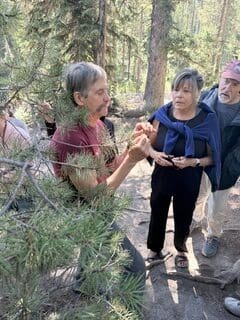
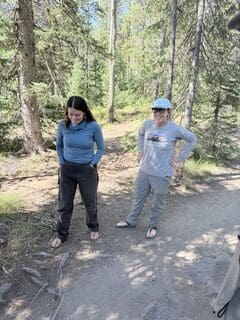
At our next detour, Ed, Eileen and Tessa decided it was time for an educational moment and taught us how to identify some of the evergreen trees we’d been walking past for three days without giving them much thought. And naturally, there was a song.
Or perhaps more accurately, a rhyme with choreography.
“Firs are flat and friendly,
Pines come in packets,
If you fall into a spruce,
you better have a jacket.”
The idea is actually pretty clever. Fir needles are generally flat and soft. Pine needles grow together in little bundles—or “packets.”And spruce needles are sharp enough that if you fall into one, apparently your clothing becomes an important part of the experience.
I am now practically a botanist.
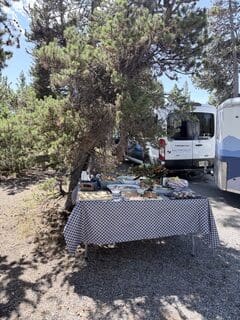
From there, we drove almost all the way to Yellowstone’s South Entrance and stopped for one of our Backroads picnic lunches. And let’s talk about these lunches for a moment. Somehow “picnic lunch” sounds like you’re going to get a turkey sandwich and an apple. This is not what happens. Backroads spreads everything out, there are approximately 47 things to choose from, and five minutes later you’re sitting in the woods eating like you’ve been invited to a catered outdoor wedding.
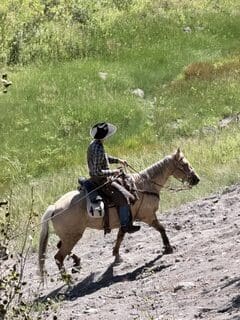
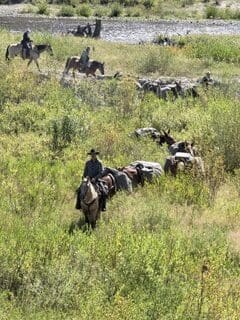
While we were eating, a group of horseback riders came out of the backcountry with some very legitimate-looking cowboys. One of the women in our group said she wanted to go talk to them. I said, “No problem. Let’s go.” Because if there are cowboys nearby, I am apparently willing to conduct some investigative journalism.
We learned that they take groups into the Yellowstone backcountry on horseback for several nights at a time—camping, fishing, riding and exploring parts of the park most visitors never see. And I immediately thought I could do that. This is how most of my future travel plans begin. Someone tells me about an activity I have never previously considered, and within approximately 90 seconds I’ve mentally purchased the appropriate wardrobe.
After lunch, it was time to leave Yellowstone behind and head toward the second major park of our trip: Grand Teton National Park. But apparently, we couldn’t leave Yellowstone without one final educational experience with a full-blown skit with props.
Ed, Eileen and Tessa decided to teach us about the early expeditions into Yellowstone, how the area eventually became a National Park, and how the men exploring the West had a habit of arriving somewhere people had already been living for thousands of years and promptly naming everything.
Naturally, this information could not simply be told to us. There had to be characters. There had to be props. There had to be acting. – In three parts (but under 5 minutes)!
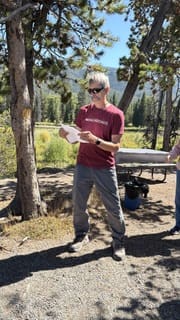
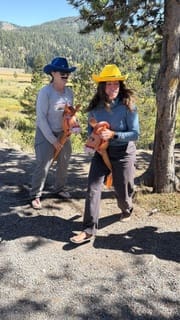
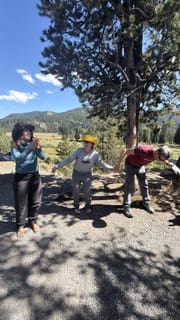
I’m certain Ed was the ringleader behind the whole production. At this point, I’m beginning to suspect that somewhere in his past he was either a very enthusiastic camp counselor or the kid who always volunteered to be in the end-of-camp talent show.
Our afternoon hike was about three miles around Colter Bay, mostly flat and easy. Colter Bay sits on Jackson Lake, although right now parts of it aren’t looking particularly lake-like.
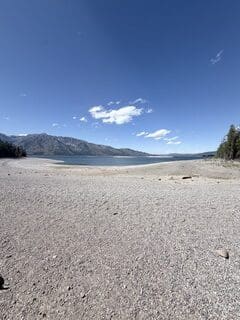
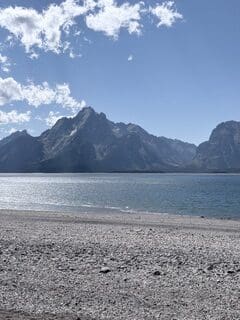
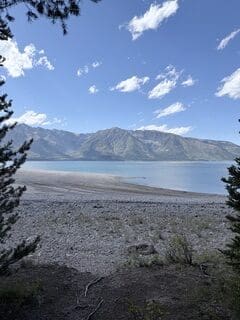
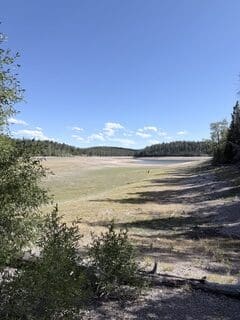
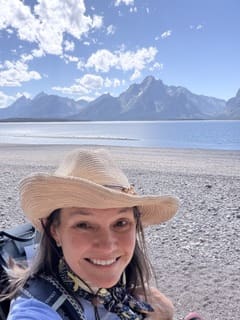
The West is dealing with drought conditions, and Jackson Lake is also a reservoir whose water is managed for irrigation downstream. With the water level so low, huge areas that would normally be underwater are exposed.
Which naturally sent a few of us down an entirely different conversational rabbit hole.
- What happens to all the fish?
- Do the fish somehow know the water is disappearing and move into what’s left?
- How many fish die?
- If there are fewer fish, what happens to the birds that eat the fish?
- And what happens to everything that eats those things?
Within about ten minutes, we’d gone from casual hikers to an uncredentialed environmental task force.
We did hear an osprey and managed to identify a few other birds, which made us feel like our morning tree-identification training had somehow expanded our overall qualifications as naturalists.
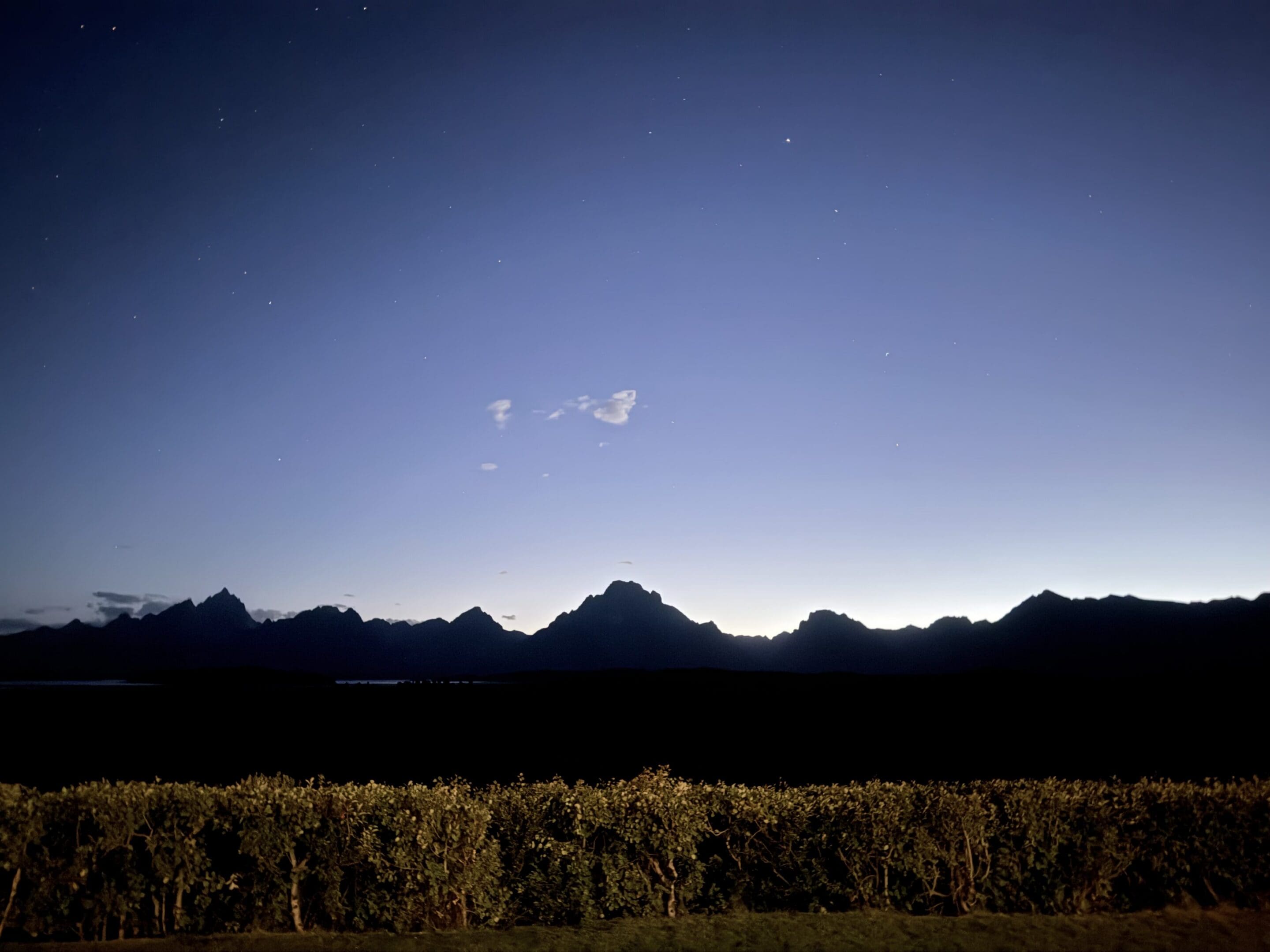
After our hike, we headed to Jackson Lake Lodge, built in the 1950s and famous for the enormous 60 foot floor-to-ceiling windows in its lobby. And when you walk in, you understand why. The windows frame Mount Moran and the Teton Range like someone built the entire hotel around a painting. Except the painting changes every few minutes. Clouds move through. The light changes. The mountains disappear and come back again.
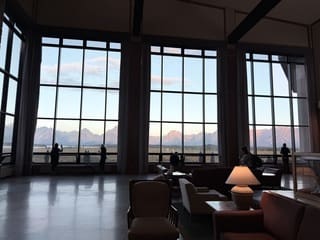
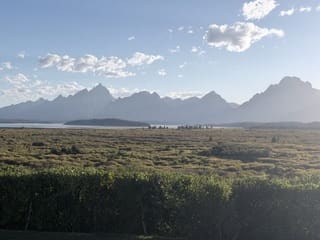
We had dinner at the lodge with that incredible view, and once again, the food was much better than I expected from a National Park hotel. Actually, the food throughout this trip has been surprisingly good. And with Backroads, there has been absolutely no danger of going hungry.
- Breakfast.
- Snack.
- Hike.
- Snack.
- Lunch.
- Hike.
- Snack.
- Dinner.
- Possibly another snack.
I’ve now adjusted to eating approximately every two hours, which is going to make returning home difficult.
Apparently, there is a reason people call it Snackroads. I’m going to get home, walk three miles around my neighborhood and wonder why nobody is waiting for me at the end with a Tootsie Roll Pop and a cheese board.