

Bison, Boardwalks & How to Dispose of a Body: Yellowstone Day Two
After a night at the Old Faithful Inn, we woke up to another beautiful day in Yellowstone. Our room actually had an incredible view of Old Faithful. Did I ever watch it erupt from my window? No. But I could have, and somehow that felt luxurious enough.
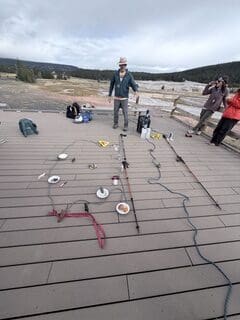
We met the group outside to hear the plan for the day, which Ed decided would best be explained through a three-dimensional topographical map of the day’s hike. It was quite a sight. I spent part of the presentation trying to follow the route and the other part watching people walk by wondering what they thought was happening.
We left Old Faithful and made a detour to somewhere I hadn’t visited on our winter trip: the overlook for Grand Prismatic Spring.
Grand Prismatic is the largest hot spring in Yellowstone, and apparently we hit the weather lottery. The sky was clear, the sun was out, and we could actually see those crazy bands of blue, green, yellow and orange that make it look like someone went a little overboard with the saturation button.
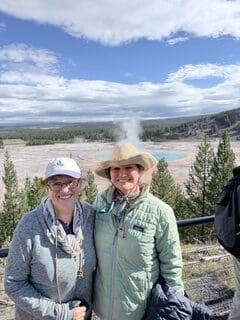
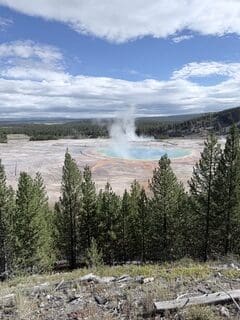
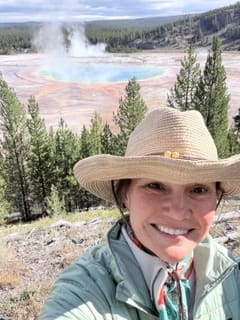
The overlook required some extra mileage, but it was absolutely worth it. Which I say now that the mileage is behind me.
From there we drove north toward the canyon and started hiking from the South Rim area, eventually making our way toward the North Rim and the Wapiti Trail—wapiti being a Native-derived word for elk.
This is the Grand Canyon of the Yellowstone, and the name fits. The canyon walls are streaked with yellows, oranges, reds and whites, and it would be very easy to assume this is how Yellowstone got its name. But it isn’t (learned this from Ed).
The name actually came from the Yellowstone River. Early French traders translated an Indigenous name for the river as Roche Jaune, or “Yellow Rock.” The name was associated with the river downstream from what is now the park, and when Yellowstone National Park was established, the river’s name came along with it.
So basically, Yellowstone was Yellowstone before anybody started making T-shirts.
The beginning of our hike took us through some crazy geothermal areas where the earth bubbled, steamed and generally looked like it was experiencing some sort of medical emergency. Parts of Yellowstone don’t look like Earth at all. They also don’t smell particularly good.
The sulfur smell coming off some of these areas is impressive. Yellowstone is visually spectacular, but occasionally smells like the entire park ate something it shouldn’t have.
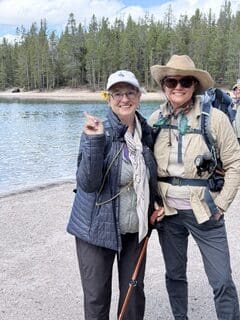
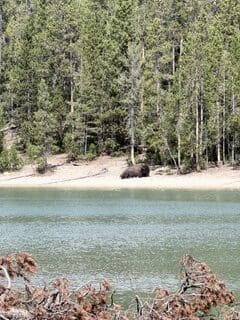
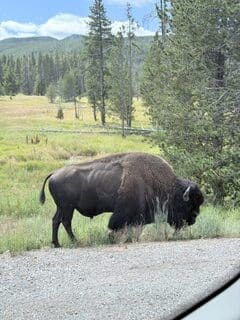
Eventually we came to Clear Lake, where we spotted a couple of buffalo across the way lounging in the sunshine. Except they weren’t buffalo. They were bison.
Which brings me to today’s educational portion of the journal. Buffalo vs. Bison
Bison are native to North America and Europe. They’re the giant shaggy animals with the big shoulder hump, enormous heads and relatively short horns. True buffalo are native to Africa and Asia. Early European settlers started calling North American bison “buffalo,” and apparently everyone just decided to go with it for the next several hundred years.
So those animals wandering through Yellowstone and creating traffic jams? Bison. Which means the Buffalo Bills really should be the Buffalo Bison. Josh Allen, please get on that.
Anyway, one of our first bison was hanging out near Clear Lake, apparently completely unconcerned by the sulfur smell. I wasn’t sure whether a bison would actually drink that water, but I also wasn’t going over there to ask him.
Back to the hike. The landscape just kept changing until eventually we came to a spectacular overlook high above the canyon and Yellowstone River.
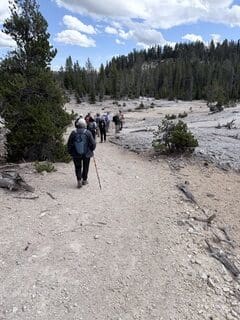
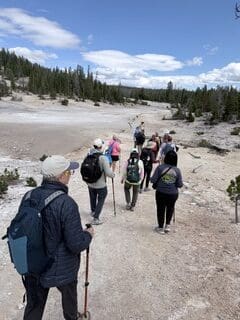
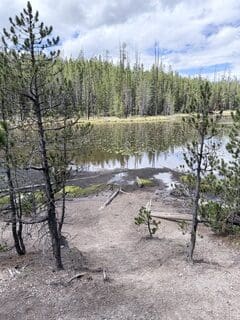
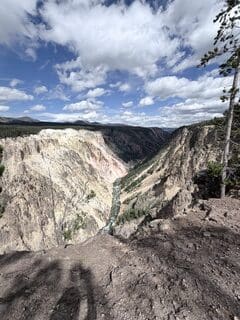
If you’re afraid of heights, this is one of those places where you admire the view from approximately six feet farther back than everyone else.
We stopped there and pulled out the lunches we’d packed. Mom announced that she was just as happy to see lunch as she was to see the canyon. She was hungry — fair enough.
Then Ed started passing around Tootsie Roll Pops, which cracked me up because apparently our guide had decided that what our sophisticated Backroads hiking group needed while overlooking one of America’s great natural wonders was candy from 1978. And, naturally, everyone wanted one. – I took two: orange and cherry.
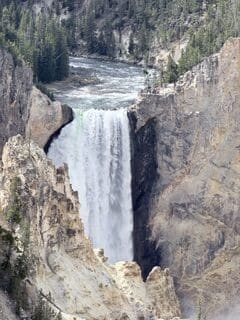
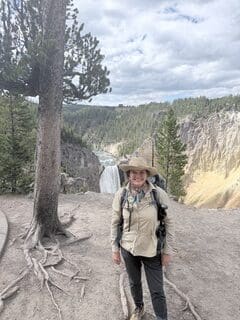
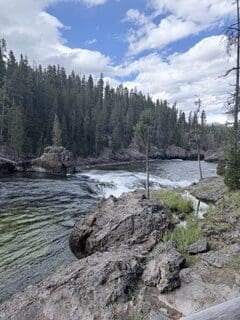
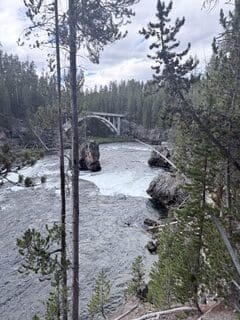
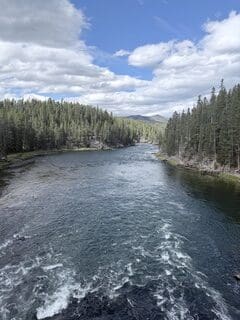
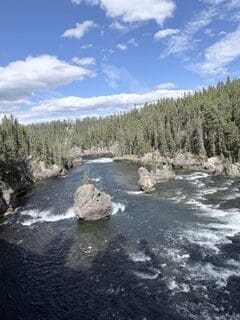
After lunch, we had a decision to make. Those who had had enough could hike out. Those of us who apparently hadn’t learned anything could continue. I chose to continue with a few others, following the trail around the river, crossing over toward the North Rim and seeing several beautiful waterfalls along the way.
Eventually we made it back to the van, tired and very happy to sit down. We drove through Hayden Valley on our way to Yellowstone Lake, and this was where we finally started seeing lots of bison. They were scattered across the valley grazing, and we stopped to watch them for a while.
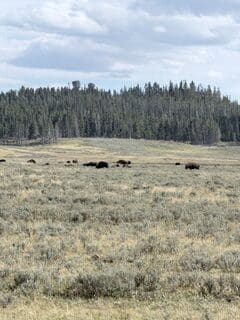
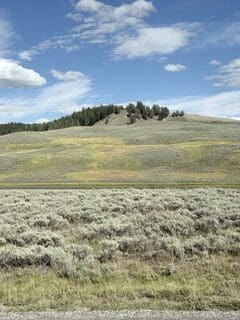
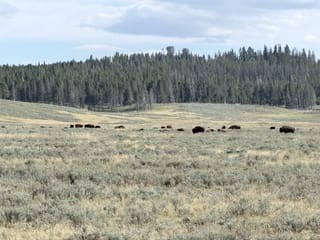
Ed told us that some trips don’t see many bison or other animals, which surprised me. When we’d been here in winter, we’d seen tons of wildlife, so I was very excited that the bison were finally showing up for us.
Then Ed pointed out the Sulphur Caldron. This is where our wholesome national park experience took a slight turn. Ed explained how incredibly acidic the water is and then casually mentioned that if you dumped a body into it that it would only take 12 hours and it would be gone.
Now, there are certain pieces of information you can tell me and expect me simply to say, “Wow, that’s interesting.” This was not one of them. I immediately had questions:
- “Can you get into the park 24 hours a day?”
- “Are there cameras around the Sulphur Caldron?”
- “Is anyone actually watching those cameras?”
- “How often do they check?”
At some point I realized everyone in the van was looking at me. I’m not saying I have a body to dispose of. I’m just saying that once someone presents a potential logistical solution, it seems irresponsible not to ask a few follow-up questions.
We finally arrived at the historic Lake Yellowstone Hotel, which has been welcoming guests in one form or another for well over a century.
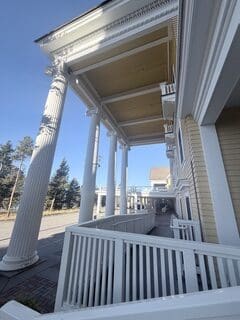

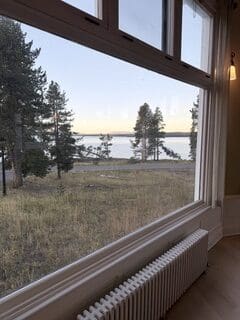
And it couldn’t feel more different from Old Faithful Inn. Old Faithful Inn is dark, massive, rustic and full of logs. Lake Yellowstone Hotel is bright and airy, with big windows, white columns and a much more elegant feel. But it’s still a government run 100-year hotel so it’s not that elegant.
And then there’s the lake itself. Yellowstone Lake is enormous. I don’t know why this surprised me so much. I’ve been to Yellowstone before. I’ve looked at maps. Presumably I understand the basic concept of a lake. But somehow, I had never processed just how much water was sitting in the middle of Yellowstone National Park.
So we ended the day staring out over Yellowstone Lake, tired, well-fed and considerably more educated than when we started. I now know the difference between a buffalo and a bison, how Yellowstone got its name, and apparently how to dispose of a body. Backroads really does cover everything.