

In Louisville thinking about Goats 🐐
I love cashmere. It’s soft, warm, and light—like regular wool but without the scratchy resentment. It also just feels good, the way luxury items do when you pretend they’ve always been a part of your life. For years, I assumed cashmere was just fancy sheep wool, the kind you get when a sheep has a trust fund.
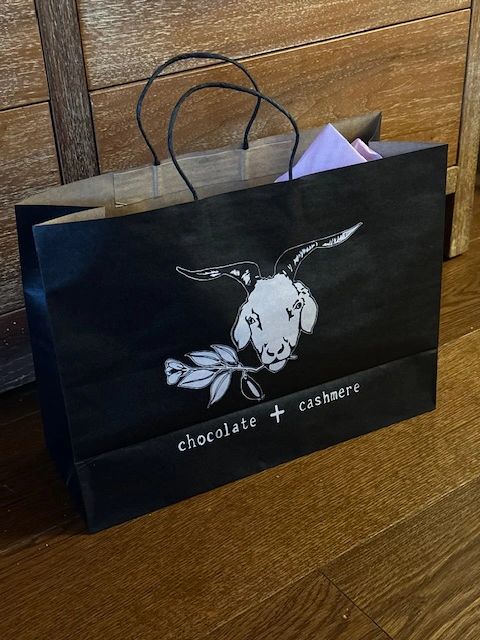
When we were in Santa Fe, I wandered into a shop called Chocolate+ Cashmere — two of my favorite things, conveniently sold under one roof. Their logo was a goat holding a branch from a chocolate tree, which struck me as a little weird. A goat? I figured it was some abstract artistic reference. (Maybe some to do with Georgia O’Keeffe)
Still, it bugged me. Later, I Googled “Where does cashmere sheep come from?” and learned—brace yourself—cashmere comes from goats. Not sheep. Goats. A fact that, apparently, I had failed to learn for the last 50 years. — More Google info: “wool” is a term and is the fleece of animals, primarily sheep, but also goats, rabbits, alpacas, and even camels. (Now you know.)
This led me to think a lot about goats lately. They are remarkably useful. They give us milk and cheese, they eat weeds, clear land, and seem genuinely friendly. In Paris, I once saw goats trimming the grass in a public park, like tiny, four-legged landscapers. The whole thing was oddly dignified.
This week, Chad and I are in Louisville for a Lawyers Who Are Pilots Conference (because apparently that’s a thing). One of the activities for the co-pilots—which is what they call the partners of these lawyer-pilots, because nothing says “romance” like aviation metaphors—was reading Horse by Geraldine Brooks. I’d read it before and liked it. The book makes you think about the deep connection between horses and humans, especially Lexington, the legendary 19th-century racehorse. His actual skeleton is now on display at the International Museum of the Horse, which seems like a particularly intense way to honor an athlete.
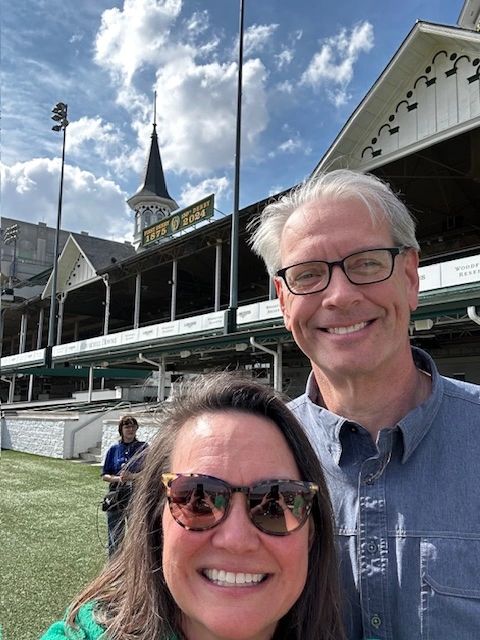
Being in Louisville, we had to visit Churchill Downs and the Kentucky Derby Museum. We saw The Greatest Race—a 360° film meant to stir the soul—and walked to the edge of the racetrack, which, in person, is huge. The whole experience made me want to come back for an actual race and maybe tour the stables when the horses are there. Apparently, they race 75 days a year, with the Kentucky Derby as the main event—a two-minute spectacle in which only three-year-old horses are allowed to compete.
There’s something undeniably romantic about going to the races, but that may be because I watched My Fair Lady one too many times as a kid. Audrey Hepburn in that enormous hat, the spectacle of it all—it’s impossible not to be charmed. Modern Derby photos show crowds of people in ridiculous hats, and I get it. The green and white of Churchill Downs makes for the perfect backdrop. Who wouldn’t want to be part of that fantasy?
But now, I have doubts. The race lasts two minutes. The rest of the time, you’re crammed into a sweaty mass of drunk people with overpriced mint juleps and terrible parking. Is that worth it?
Still, there’s something about horses—their power, their grace—that keeps us captivated. What puzzles me, though, is that we don’t need them anymore. They don’t give us milk. They don’t make cheese. And they definitely don’t produce cashmere.
Maybe it’s time we start a new tradition:
The Goat Derby.
Now that’s something I’d buy a hat for.
Crosswind Note:
We stayed in downtown Louisville on historic West Main Street at the 21c Museum Hotel. The room was nice, and when I asked if they could make the shower hotter—they did! The food and drinks at the restaurant were also delicious.
Another fun side adventure we took was a glassblowing class at Flame Run, a glassblowing studio and gallery. During the class, we got to step into the studio’s hot shop, where, with the help of Adam, we learned the basics of working with hot glass. We even made our own glass paperweights—or as we like to call them, lumps. Definitely a great alternative to the usual bourbon tour!
